Sunday, 8 December 2013

Relatives and inhabitants remember the Lockerbie disaster

[Today’s edition of The Sunday Times contains (behind the paywall) an article headlined Lockerbie remembers. It reads in part:]

Relatives of those killed in the Lockerbie bombing and others who survived say those who died would not want them to be bitter about Britain’s worst terrorist attack.
Speaking on the eve of the 25th anniversary, they said the bombing victims would want them to live “joyfully” rather than give in to terrorism.
Others taking part in a new television documentary about the bombing of Pan Am Flight 103, which exploded over Dumfriesshire, have told how the horror of the atrocity, which claimed 270 lives, still lives with them daily.
As Scottish prosecutors continue to investigate the attack, following the death last year of the convicted bomber Abdelbaset Ali al-Megrahi, some of those touched by the tragedy have relived the events around December 21, 1988. (...)
Lockerbie priest [RB: and Justice for Megrahi committee member] Fr (now canon) Patrick Keegans described the moment of impact as he realised he had to get his elderly mother out of their house and away from the flames. He lived at Sherwood Crescent, where the fuselage of the jet landed, destroying three homes and claiming the lives of several residents. “The whole house went dark and shook so much it was impossible to move. I thought, ‘I’m going to die here’ and then everything went still. I opened the front door and the street was gone. The whole street was on fire. There were fires in the garden, rubble and debris everywhere.” (...)
For many relatives of those killed in the attack, the release on compassionate grounds of Megrahi, three years before his death, after being diagnosed with terminal cancer has been a source of anger.
However, Keegans believes the victims would not want those who survived to be bitter. “If those who have died were able to speak to us just now, what would they say? ‘Live your lives joyfully because that’s how we want you to live your lives.’
"Because in the back of my head, there was this thought, we’re not going to allow the terrorists to have our lives as well.”
Janine Boulanger, whose 21-year-old daughter Nicole was returning to the United States after six months in Britain, agrees.
“The world is full of hate and terror and I have decided that I need to concentrate on the goodness that surrounds us and the beauty of life because I don’t think my daughter would want anything else,” she said.
The Lockerbie Bombing is broadcast on December 17 at 9.30pm on STV and 11pm on ITV

Is the real Lockerbie bomber in Sweden after spending 20 years in prison?

[This is the headline over a report, labelled “exclusive”, published today in the Scottish edition of the Sunday Express.  It reads as follows:]

A convicted terrorist accused of being the real Lockerbie bombing culprit has been traced as part of a new documentary marking the disaster's 25th anniversary.

Mohammed Abu Talb will feature in a special Al Jazeera programme - due to be screened later this month - after being tracked down living quietly in Sweden.

The 59-year-old Egyptian militant spent 20 years in a Swedish jail for terror attacks in Copenhagen and Amsterdam but was released in 2009 and until now his whereabouts have been unknown.

The investigation will reveal new information on the movements of Talb - once a prime suspect in the Lockerbie case - in the days before Pan Am Flight 103 exploded over Scotland on December 21, 1988.

It is understood the potentially vital evidence did not come to light during the trial of Abdelbaset al-Megrahi - the only man to be convicted of the atrocity - and was not discovered during a review of the case.

Megrahi was found guilty at The Hague in 2001 after judges heard how clothes he allegedly purchased in Malta were said to have been wrapped around the bomb when it detonated killing 270 people.

But Talb, who was the focus of Scottish detectives early in the investigation, was also found to have been in Malta on at least one occasion in the months leading up to the attack.

The Scottish Criminal Cases Review Commission raised several concerns over Megrahi's conviction, most of which relate to his identification by shopkeeper Tony Gauci, who sold the clothes.

It is claimed, at one stage, Gauci identified the mysterious shopper as Talb.

The Commission also says evidence indicates the clothing was bought prior to December 7, the only date Megrahi could have made the purchase.

The latest revelation has been welcomed by lobby group Justice For Megrahi (JFM) which believes the former Libyan security officer was innocent and has long campaigned for his conviction to be overturned.

Speaking yesterday, JFM member Professor Robert Black, a lawyer who was the architect of the Lockerbie trial, said: "I haven't been involved in this documentary at all but I've heard from other sources that they have tracked down Abu Talb.” 

Following his arrest in May 1989, Talb's home in Uppsala, Sweden, was searched by police who found a 1988 calendar with the date of the ill-fated flight circled. In addition, his wife was secretly recorded ordering an unidentified Palestinian to "get rid of the clothes immediately".

Talb, who is said to have connections with the Popular Front for the Liberation of Palestine-General Command, denied any involvement and investigators focused their attention on Megrahi.

The documentary, If Not Megrahi, Then Who?, is directed and produced by Bill Cran and Christopher Jeans and will be broadcast later this month. It follows two previous programmes, called Lockerbie: The Pan Am Bomber and Lockerbie: Case Closed.

Mr Jeans yesterday said he was unable to discuss the documentary at this time, while an Al Jazeera spokesman confirmed the show was in the production stage but refused to comment further.

Saturday, 7 December 2013

"In our thoughts and prayers continuously"

[Nelson Mandela's message to Megrahi is the heading over an item posted today on John Ashton’s website Megrahi: You are my Jury.  It reads as follows:]

Nelson Mandela visited Abdelbaset al-Megrahi in Barlinnie prison on 10 June 2002. Here is Abdelbaset’s account of the visit and below it a photo of the two men together and one of the inscriptions that Mr Mandela wrote in an Arabic version of his book Long Road to Freedom, which he gave to Abdelbaset:

Three months after my transfer to Barlinnie, Nelson Mandela kept his promise to visit me. That the world’s most respected statesman should again take the trouble to demonstrate his solidarity gave me a great lift. We chatted for sometime, mainly about the unjust guilty verdict. Having spent 27 years imprisoned on Robben Island, the agonies of prison life were etched into his soul. He asked me about my living conditions, the standard of my food and my bed, clearly aware of the huge importance of those things to a prisoner’s wellbeing. Before he left I introduced him again to my family, who thanked him and presented him with a bouquet of flowers. I was allowed to take photographs of him in the reception area and he signed my Arabic version of his book Long Walk to Freedom, which describes his prison years. In it he wrote: ‘To Comrade Megrahi, Best wishes to one who is in our thoughts and prayers continuously. Mandela.’

Following the meeting he held a press conference, in which he declared: ‘Megrahi is all alone. He has nobody he can talk to. It is a psychological persecution that a man must stay for the length of his long sentence all alone.’

Scottish Parliament motion: Lockerbie, 25 Years On

[This is the heading over a motion tabled in the Scottish Parliament on 5 December by Christine Grahame MSP, convener of the Justice Committee.  It reads as follows:]

Motion S4M-08526: Christine Grahame, Midlothian South, Tweeddale and Lauderdale, Scottish National Party, Date Lodged: 05/12/2013

Lockerbie, 25 Years On

That the Parliament notes that 21 December 2013 marks the 25th anniversary of the Lockerbie bombing when Pan-Am Flight 103 was destroyed over the town of Lockerbie with the loss of all lives on board, 243 passengers, 16 crew, and 11 Lockerbie residents; recognises the commitment of the people of Lockerbie to the memory of those lost, where at the Dryfesdale Cemetery a semi-circular stone wall in the garden of remembrance lists the names and nationalities of all the victims along with individual funeral stones and memorials and also recognises the continuing kindness and sensitivity to relatives of those killed while wishing to restore normality to their town; considers that, notwithstanding the conviction of Abdelbaset al Megrahi, this remains unfinished business, but, for the moment, simply wishes to express the continuing sorrow at so many lost lives.

[Up to this morning the motion had been supported by the following MSPs:]

Jim Hume, Nigel Don, Angus MacDonald, Bill Kidd, Joan McAlpine, Chic Brodie, Dennis Robertson, Gil Paterson, Annabelle Ewing, Colin Beattie, Christian Allard, Richard Lyle, Mike MacKenzie, John Mason, Stuart McMillan, Clare Adamson, John Finnie.

Nelson Mandela and Abdelbaset Megrahi

[An article appears in today’s edition of The Herald headlined He brokered Lockerbie trial agreement.  It reads as follows:]

Nelson Mandela caused a stir when he called for Abdelbaset Ali Mohmed al Megrahi, the man convicted of the Lockerbie bombing, to be released from his Glasgow cell and said he felt the Libyan had suffered an injustice.

He had visited the convicted Megrahi in Barlinnie prison in 2002 having been credited with helping to break the diplomatic deadlock between Libya, the US and Britain that allowed Megrahi's trial to go ahead.

The former South African president had helped to persuade Colonel Muammar Gadaffi, the Libyan president, to hand over the two men accused of planting the bomb, convincing him that they would receive a fair trial.

Mandela was said, however, to have been disappointed when it was agreed that a Scottish court sitting in the Netherlands was to try the men. He had favoured an international panel of judges.

The South African arrived at the Glasgow jail heavily guarded by a posse of police officers, diplomats and South African secret servicemen.

Mandela, who spent 27 years in Robben Island prison for his opposition to South Africa's apartheid regime, backed calls for a fresh appeal into Megrahi's conviction and an independent inquiry into the December 1988 bombing of the Pan Am jet, which claimed the lives of 270.

And he caused outrage when he pleaded to the Government for the Libyan to be transferred from Barlinnie to serve his minimum 20-year sentence in a Muslim country, such as Tunisia or Egypt, where he would not feel so isolated. He described Megrahi's solitary confinement as nothing short of "psychological persecution".

He said: "I profited a great deal by serving my sentence with other people. Our minds were occupied every day by something positive. For that reason it's difficult for me to believe that I was in jail for 27 years or so."

But Foreign Secretary Jack Straw said that the move was out of the question.

Mr Straw quoted a report by independent UN monitors who had visited Megrahi at Barlinnie and concluded that his conditions were "good, meeting all known national and international standards".

Mr Straw added that Megrahi's guards had shown "commendable awareness of, and respect for, cultural and religious differences".

Four years ago, when the Scottish Justice Secretary Kenny MacAskill was under intense pressure following the release of the Libyan on compassionate grounds, it emerged the Scottish Government received a letter saying the former South African president expressed his support for the move.

In the letter to the Scottish government, Professor [Jakes] Gerwel, the chairperson the Mandela Foundation, said: "Mandela sincerely appreciates the decision to release Megrahi on compassionate grounds."

It added: "Mandela played a central role in facilitating the handover of Megrahi and his fellow accused to the United Nations in order for them to stand trial under Scottish law in the Netherlands.

"His interest and involvement continued after the trial after visiting Mr Megrahi in prison.

"The decision to release him now, and allow him to return to Libya, is one which is therefore in line with his wishes."

Scottish First Minister Alex Salmond said there was "huge support" internationally for the decision to free Megrahi - who had terminal prostate cancer - to allow him to return home to Libya to die.

Mr Salmond said: "We have seen that Nelson Mandela has come out firmly in support, not just as the towering figure of humanitarian concern across the world in the last generation, but of course somebody who brokered the agreement that led to the Lockerbie trial in the first place."

He added: "Many people believe that you will achieve more in this world through acts of mercy than you will through acts of retribution." 

[An article published yesterday on the BBC News website contains the following:]

[Mandela’s] warmest praise was for Glasgow, for the support the city had given to him and his fellow prisoners.

"Whilst we were physically denied our freedom in the country of our birth, a city 6,000 miles away, and as renowned as Glasgow, refused to accept the legitimacy of the apartheid system and declared us to be free.

"It is for this reason that we respect, admire and above all, love you all."

Outside the City Chambers, Nelson Mandela lit up the grey October day, joining the dancers on stage and wowing the crowd with his own Mandela shuffle.

That was not the end of Nelson Mandela's connection with Scotland, or indeed with Glasgow.


Mr Mandela visited Megrahi in Barlinnie prison

He became a key figure in the negotiations which brought the two Libyans accused of the Lockerbie bombing to trial at Camp Zeist in the Netherlands.

Mandela argued the men ought to be tried in a neutral country

After Abdelbaset al-Megrahi was convicted and brought to Scotland, Mandela visited him in Barlinnie.

I was there when he told a packed press conference inside the prison he believed Megrahi should be allowed a fresh appeal and should be transferred to serve his sentence in a Muslim country.

Seven years on, Nelson Mandela wrote to the Scottish government backing the decision to release Megrahi on compassionate grounds.

[Rivonia is the title of a magnificent song written in 1963 by poet, singer and song-writer Hamish Henderson. You can listen to it here.]

Friday, 6 December 2013

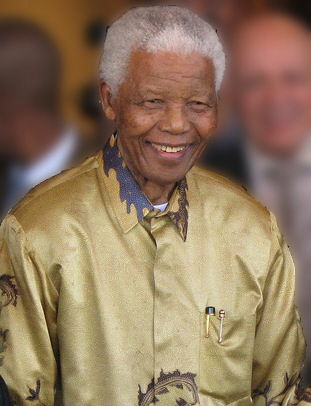
RIP Nelson Mandela

18 July 1918 - 05 December 2013


Among his many other achievements, Nelson Mandela played a significant and honourable part in the Lockerbie affair.  Here are a few excerpts from posts on this blog over the years.

Saturday, 12 January 2008  He [Abdelbaset Megrahi] spoke affectionately and admiringly of South African leader Nelson Mandela, who had visited him in prison, saying that Mandela refused to be accompanied by any British official when he visited him in his prison in Scotland. He added that Mandela also called him when he was visiting the Netherlands because his Dutch hosts had told him that he cannot visit him in prison as it would be a breach of protocol.

Friday, 18 July 2008  (on Mandela’s 90th birthday) 'With so much having been written about the man, the best insights can, perhaps, be gleaned from his 'lesser' successes rather than his iconic triumphs. Nowhere is this more evident than in his mediation on the Lockerbie issue. Mandela took a particular interest in helping to resolve the long-running dispute between Gaddafi's Libya, on the one hand, and the United States and Britain on the other, over bringing to trial the two Libyans who were indicted in November 1991 and accused of sabotaging Pan Am Flight 103, which crashed at the Scottish town of Lockerbie on 21 December 1988, with the loss of 270 lives. As early as 1992, Mandela informally approached President George Bush with a proposal to have the two indicted Libyans tried in a third country. Bush reacted favourably to the proposal, as did President Mitterrand of France and King Juan Carlos of Spain. In November 1994, six months after his election as president, Mandela formally proposed that South Africa should be the venue for the Pan Am Flight 103 bombing trial.

'However, British Prime Minister, John Major, flatly rejected the idea saying the British government did not have confidence in foreign courts. A further three years elapsed until Mandela's offer was repeated to Major's successor, Tony Blair, when the president visited London in July 1997. Later the same year, at the Commonwealth Heads of Government Meeting (CHOGM) at Edinburgh in October 1997, Mandela warned: "No one nation should be complainant, prosecutor and judge." A compromise solution was then agreed for a trial to be held at Camp Zeist in the Netherlands, governed by Scottish law, and Mandela began negotiations with Gaddafi for the handover of the two accused (Megrahi and Fhimah) in April 1999.

‘At the end of their nine-month trial, the verdict was announced on 31 January 2001. Fhimah was acquitted but Megrahi was convicted and sentenced to 27 years in a Scottish jail. Megrahi's initial appeal was turned down in March 2002, and former president Mandela went to visit him in Barlinnie prison on 10 June 2002. "Megrahi is all alone", Mandela told a packed press conference in the prison's visitors room. "He has nobody he can talk to. It is psychological persecution that a man must stay for the length of his long sentence all alone. It would be fair if he were transferred to a Muslim country, and there are Muslim countries which are trusted by the West. It will make it easier for his family to visit him if he is in a place like the kingdom of Morocco, Tunisia or Egypt."’

Sunday, 30 August 2009  Nelson Mandela played a central role in facilitating the handover of Megrahi to the United Nations so he could stand trial under Scottish law in the Netherlands, and subsequently visited him in Barlinnie Prison in Glasgow.

His backing [for the compassionate release of Megrahi] emerged in a letter sent by Professor Jakes Gerwel, chairperson of the Mandela Foundation.

He said: "Mr Mandela sincerely appreciates the decision to release Mr al Megrahi on compassionate grounds.

"His interest and involvement continued after the trial after visiting Mr al Megrahi in prison.

"The decision to release him now, and allow him to return to Libya, is one which is therefore in line with his wishes."

Sunday, 14 February 2010  I have no doubt that President Mandela's influence and his interventions at the time of the Commonwealth Heads of Government Meeting (CHOGM) in Edinburgh in October 1997 were crucial in persuading the recently-elected Labour Government to countenance a "neutral venue" solution to the Lockerbie impasse. Also of crucial importance was the press conference held by the group UK Families-Flight 103 in Edinburgh during the Meeting and the worldwide publicity that it generated.

Friday, 17 June 2011  In November 1994, President Nelson Mandela offered South Africa as a neutral venue for the trial but this was rejected by John Major. A further three years elapsed until Mandela’s offer was repeated to Major’s successor, Tony Blair, when the president visited London in July 1997 and again at the 1997 Commonwealth Heads of Government Meeting in Edinburgh in October 1997. At the latter meeting, Mandela warned that “no one nation should be complainant, prosecutor and judge” in the Lockerbie case.

Sunday, 24 July 2011  Huge crowds greeted Nelson Mandela as he travelled from South Africa to meet Abdelbaset al-Megrahi.

He met the Libyan convicted of the Lockerbie bombing in 2002 on a diplomatic excursion to see how he was being treated.

The former president of South Africa also discussed a campaign for Megrahi to serve his sentence in a Libyan prison.

Everyone who has met Mandela speaks of his kindness, gentleness and good manners.

His visit to Gaddafi's Cafe, the nickname given to the area of Barlinnie where Megrahi was held, underlined the humanity of the man.

After all, Mandela himself spent 18 of his 27 years in jail on Robben Island after being locked up by the South Africa's apartheid government.

Most of the crowd hoping to meet him were positioned around the reception and the main gates. Everyone on the staff wanted a glimpse of the great man. The wellwishers were rows deep.

But as he passed through the throng, Mandela stopped, looked to the edge of the crowd and spotted a young prison officer right at the back.

He said: "You sir, step down here."

When the officer got to the front, Mandela shook his hand, giving him a moment he would never forget.

Mandela remarked that he, too, knew what it was like to be at the back row and not noticed.

The great leader then went inside to meet Megrahi. [RB: Here is a photograph taken at the time.]


But he declined an offer to visit the cell blocks.

Mandela had seen enough to last a lifetime.

Wednesday, 29 February 2012  I [Dr John Cameron] first became involved in the Lockerbie case when Nelson Mandela asked the Church of Scotland to support his efforts to have Abdelbaset al-Megrahi's conviction overturned. 

As an experienced lawyer, Mandela studied the transcripts and decided there had been a miscarriage of justice, pointing especially to serious problems with the forensic evidence. I was the only research physicist among the clergy and was the obvious person to review the evidence to produce a technical report which might be understood by the Kirk.

Scientists always select the competing hypothesis that makes the fewest assumptions to eliminate complicated constructions and keep theories grounded in the laws of science. This is 'Occam's razor' and from the outset the theory that the bomb entered the system in Malta as unaccompanied baggage and rattled around Europe seemed quite mad. I contacted everyone I knew in aviation and they all were of the opinion it was placed on board at the notoriously insecure Heathrow and that the trigger had to be barometric.  

[And while listening to or reading the tributes to Mandela from members of the UK government and Tory politicians, just bear this in mind.]

Wednesday, 4 December 2013

Scottish Cabinet Secretary haunted by Robertson Lockerbie novel

[The Sunday Herald this week ran the second part of its feature in which various Scottish figures select their favourite books of 2013.  Here is part of what two of them wrote:]

Ron Butlin, author: James Robertson's The Professor Of Truth (Hamish Hamilton, £16.99) is a masterly novel that not infrequently touches on the Lockerbie bombing. Fine storytelling, great characterisation and with no unnecessary detail, it is a compelling thriller that succeeds also as a work of quality literary fiction. 

Michael Russell MSP, Cabinet Secretary for Education and Lifelong Learning: James Robertson is Scotland's literary chronicler par excellence, and his ability to make us feel uncomfortable but immensely better informed about the human condition is perfectly in evidence in The Professor Of Truth (Hamish Hamilton, £16.99), which is by far the best book I have read this year. Visual and cerebral, it still haunts me, months after I devoured it in a sitting.

[Would that Mike Russell would turn his very considerable gifts of persuasion to convincing his Scottish Government colleagues, and particularly the Scottish law officers, to do the right thing about Lockerbie and the shameful conviction of Abdelbaset Megrahi.]

Tuesday, 3 December 2013

Lockerbie tragedy anniversary documentary to be broadcast by STV

[This is the headline over an item posted recently on the Allmedia Scotland website.  It reads as follows:]

A documentary marking the 25th anniversary of the Lockerbie tragedy – when a Pan Am flight exploded in the skies over the town – is to be broadcast by STV.

Says the broadcaster of the hour-long documentary, which will be transmitted on the 17th of [December] at 9.30pm, it is to feature “eyewitness testimony with unique archive footage to tell the story of what happened”.

The tragedy claimed the lives of all 259 passengers and crew on board the plane, on a non-stop transatlantic flight between London and New York. 11 Lockerbie residents also died.

Adds STV: “Footage from STV’s news archives, including some material that has never previously been broadcast, is combined with first-hand testimonies from local residents who relive the events of 21st December 1988 on camera in their own words.

“The documentary also hears from four families of American victims of the tragedy and members of the emergency services who responded to the disaster.”

Elizabeth Partyka, deputy director of channels at STV, is quoted, as saying: “This brand new documentary includes the first-hand accounts of some Lockerbie residents who have never spoken on camera before and through their stories, and that of many others involved, builds a definitive account of what happened 25 years ago. The Lockerbie Bombing tells a story of a night in Scottish history that should be remembered and this is a timely tribute.”

Alan Clements, director of content for STV and executive producer of The Lockerbie Bombing, is also quoted, as saying: “I was working in the BBC newsroom in 1988 and was on site at Lockerbie within a few hours of the plane coming down. We worked through the night to put the breakfast news on air and the experience of being in that small town as the full extent of the tragedy unfolded is one that I will never forget. It is an honour that the people involved in this programme have allowed us to tell their story and I hope it is a story that will never be forgotten.”

The Lockerbie Bombing is produced by STV Productions for STV and Smithsonian. The documentary will be also broadcast on ITV on Tuesday, December 17 at 11pm.

Monday, 2 December 2013

The worst unrectified miscarriage of justice in modern British history

[Today’s edition of The Times contains a brief article (behind the paywall) about the new musical based on the Profumo affair and the Stephen Ward trial. It reads in part:]
Profumo-linked trial is centre stage again
It is, a leading barrister will claim today, “the worst unrectified miscarriage of justice in modern British history”. It is also the subject of Andrew Lloyd Webber’s latest musical. The life and death of the society osteopath Stephen Ward and his connection with a scandal that brought down the Government 50 years ago continues to fascinate.

Geoffrey  Robertson, QC, will today call for the release of court papers in the National Archives and will claim that Ward was the victim of a smear campaign by the British Establishment, embarrassed at a sex scandal involving  John Profumo, the Secretary of State for War.

Ward died in August 1963 after an overdose of sleeping pills on the last day of his trial at the Old Bailey on charges of living off the alleged prostitutes  Christine Keeler and Mandy  Rice-Davies. As he lay in a coma, the jury reached a guilty verdict. In a book, Stephen Ward was Innocent, OK, Mr Robertson says this should be overturned.

“His trial was a farce,” Mr Robertson wrote in a newspaper yesterday. “There was no real evidence against him. Appeal judges hid evidence of his innocence and the trial judge improperly directed the jury to convict him on speculation.”

[The worst unrectified miscarriage of justice in modern British history? The Stephen Ward trial? Really? While the conviction of Abdelbaset al-Megrahi for the Lockerbie bombing remains unrectified? Mr Robertson seems to me to have gone overboard in his attempt to plug his book.  But he has always been curiously ill-informed and wrong-headed about the Megrahi case.]

Sunday, 1 December 2013

Aljazeera's "Lockerbie: The Pan Am Bomber"

The first of Aljazeera’s three Lockerbie documentaries Lockerbie: The Pan Am Bomber (which has been previously broadcast) can be viewed on the Aljazeera English TV channel tonight at 20.00hrs GMT.  It is also to be shown during the coming week on Monday, Tuesday and Wednesday at various times. The second, Lockerbie: Case Closed, (also previously broadcast) is to be shown on Sunday, 8 December and the following days. The third programme, If Not Megrahi, Then Who? (which is completely new) will be shown on Sunday, 15 December and the following days.

Gaddafi's spy chief may hold key to Lockerbie

[This is the headline over a report in today’s edition of The Sunday Herald.  It reads in part:]

'I do not say that he is not guilty, I just say that he should have a fair trial," said Anoud Senussi in an interview with The Sunday Herald about her father, Abdullah Senussi, Colonel Gaddafi's former intelligence chief and the alleged mastermind behind the 1988 Lockerbie bombing.

At the former Libyan leader's side until the final months of the 2011 civil war, Abdullah fled with his family to Mauritania. According to Anoud, her father was betrayed by the Mauritanian president, who lured him to an airport meeting. "He was taken on to a plane and a man, the new Libyan minister of finance, was sitting there with $200 million in a bag. As soon as my father was on board, the minister handed over the bag. It was a business deal."

Held in Libya, Senussi faces charges over the 1996 massacre of more than 1000 inmates and for war crimes allegedly committed during the civil war. The International Criminal Court has issued a warrant for his arrest on charges of crimes against humanity. Senussi's lawyers in London are seeking his transfer to the jurisdiction of the ICC, but their initial application, since appealed, was refused. (...)

As Libya's spy chief, Senussi is thought by many to have played a key role in the Lockerbie bombing. But while he was convicted in absentia by a French court for his role in the 1989 bombing of a UTA airliner, he has not been charged in connection with Lockerbie. Instead, in 2001, Scottish judges sitting in Holland sentenced Abdelbaset Ali Mohmed al-Megrahi, a Libyan spy, to life in prison in Scotland. Questions have been raised about the safety of the conviction, and whether he was handed over in part to divert attention from the true perpetrators.

On learning that Senussi had been flown to Libya, Scottish police hurried to Tripoli. It is not clear whether they interrogated him about Lockerbie but, in a statement to The Sunday Herald, Police Scotland did not rule out having spoken to him, and confirmed they had been to Libya in connection with Lockerbie. With Senussi held incommunicado, his London lawyers could not confirm whether Scottish police had questioned him.

According to Anoud, legal proceedings against her father are being influenced to prevent him reaching a public court, given what he must know as a former spy chief. "America, Britain, France - ask them why they do not let my father come to the ICC. They do not want him to speak." Without access to legal counsel, facing closed court in Libya and on a charge punishable by death, there is every chance Senussi will never be questioned in public about the Lockerbie bombing.

"There is no justice in Libya," said Anoud. "They will kill him in Libya. In the ICC, there is justice."

[First it was Moussa Koussa who was supposedly holding the key to Lockerbie. Now it’s Abdullah Senussi. I’d have thought that by now there was enough evidence in the public domain for even the dimmest journalist or police officer to realise that the key to Lockerbie most probably does not lie in Libya.]